
Northern Beaches vs Eastern Suburbs: Where's the Real Growth?
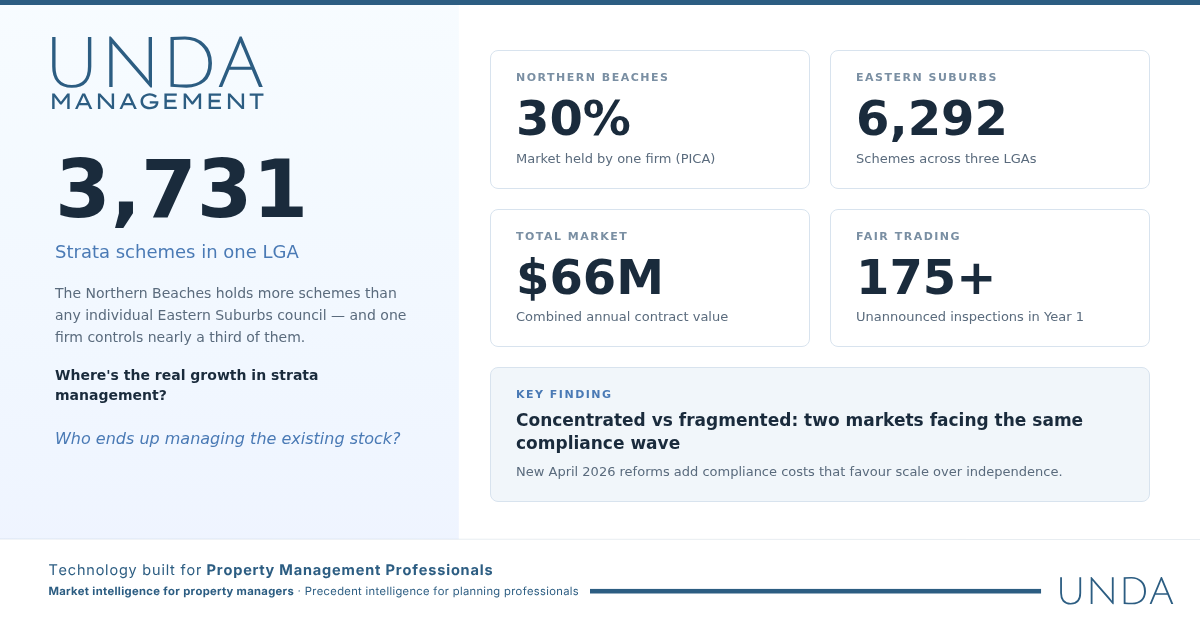
One LGA, 3,731 strata schemes, and a market concentration that should worry every independent operator on the peninsula.
The Northern Beaches has quietly become one of Sydney's largest strata management markets. Not in the abstract — in hard numbers that most people in the industry haven't seen.
UNDA tracks 89,000+ active strata schemes across NSW. When you zoom into Sydney's two most sought-after coastal corridors — the Northern Beaches and the Eastern Suburbs — the data tells a story that runs counter to conventional wisdom about where the real strata management opportunity sits.
One LGA vs Three — And It's Not the Blowout You'd Expect
The Eastern Suburbs spans three local government areas: Randwick (2,866 schemes), Waverley (1,876 schemes), and Woollahra (1,550 schemes). Combined, that's 6,292 active strata schemes managing 70,887 lots.
The Northern Beaches is a single LGA. It has 3,731 schemes and 44,006 lots.
That means one council area on the northern peninsula holds more strata schemes than any individual Eastern Suburbs council — and nearly 60% as many as all three combined. On a per-LGA basis, Northern Beaches is the clear heavyweight.
The PICA Factor
Market concentration is where the two regions diverge most sharply.
On the Northern Beaches, PICA Group manages 1,112 schemes — roughly 30% of the entire market. The next largest operator, Jamesons Group, holds 238 schemes. That's a five-to-one gap between first and second place.
In the Eastern Suburbs, the picture is different. PICA still leads with 511 schemes, but that represents just 8% of the market. Behind them, the landscape is populated by boutique firms with deep local roots: Alldis & Cox (389 schemes), O'Neill Strata Management (321), R D Wedd (299), and Bright & Duggan (193). No single operator dominates.
The Northern Beaches is a concentrated market. The Eastern Suburbs is a fragmented one. Both structures have implications for owners corporations — and for the firms competing in them.
What the Contract Values Reveal
UNDA estimates conservative annual contract values for every strata scheme based on lot composition and scheme size. Across both regions, the numbers are strikingly similar at the per-scheme level:
The Northern Beaches averages $5,323–$6,670 per scheme annually. The Eastern Suburbs averages $5,220–$6,549. Nearly identical.
But aggregate market size tells a different story. The Eastern Suburbs' total addressable market sits between $32.7 million and $41.0 million annually. The Northern Beaches: $19.8 million to $24.8 million. The Eastern Suburbs' larger scheme count creates a market roughly 65% bigger in total value — even though individual schemes are worth about the same.
Why This Matters Now
Two forces are reshaping the competitive landscape in both regions simultaneously.
First, the Strata Schemes Legislation Amendment Act 2025 completed its final tranche of reforms on 1 April 2026. Developers of multi-storey schemes must now engage an independent surveyor to verify that initial maintenance schedules meet requirements and that proposed contributions to both the administrative and capital works funds are sufficient. Maintenance schedules must use a new standardised format. Every one of these changes adds compliance overhead — and compliance overhead disproportionately affects smaller operators without dedicated governance teams.
Second, NSW Fair Trading's Strata and Property Services Taskforce — backed by $8.4 million in government funding — has completed over 175 unannounced inspections, issued roughly 80 fines totalling more than $125,000, and taken disciplinary action against over 70 licensees in its first year. The regulatory posture has shifted from complaint-driven to proactive enforcement.
In a concentrated market like the Northern Beaches, the compliance burden may actually reinforce PICA's dominance — larger operators can absorb regulatory costs across a bigger portfolio. In the fragmented Eastern Suburbs, the same burden could trigger consolidation, as boutique firms weigh whether the economics still work at 100–300 schemes.
The Question Nobody's Asking
Every strata industry conversation focuses on where the buildings are going up. New developments, new registrations, new pipeline.
But the data suggests the more interesting question is about existing stock. The Northern Beaches already has 3,731 schemes generating up to $24.8 million annually in management fees — and one firm controls nearly a third of it. The Eastern Suburbs has 6,292 schemes and $41.0 million in fees, but spread across dozens of operators, many of whom are now facing regulatory requirements that didn't exist eighteen months ago.
Where's the real growth? It might not be about new schemes at all. It might be about who ends up managing the ones that already exist.
UNDA Management tracks 89,000+ active strata schemes across NSW, including manager assignments, lot compositions, and estimated contract values. Data current as at August 2026.