
The Clause 4.6 Variation Success Rate: When Breaking the Rules Works
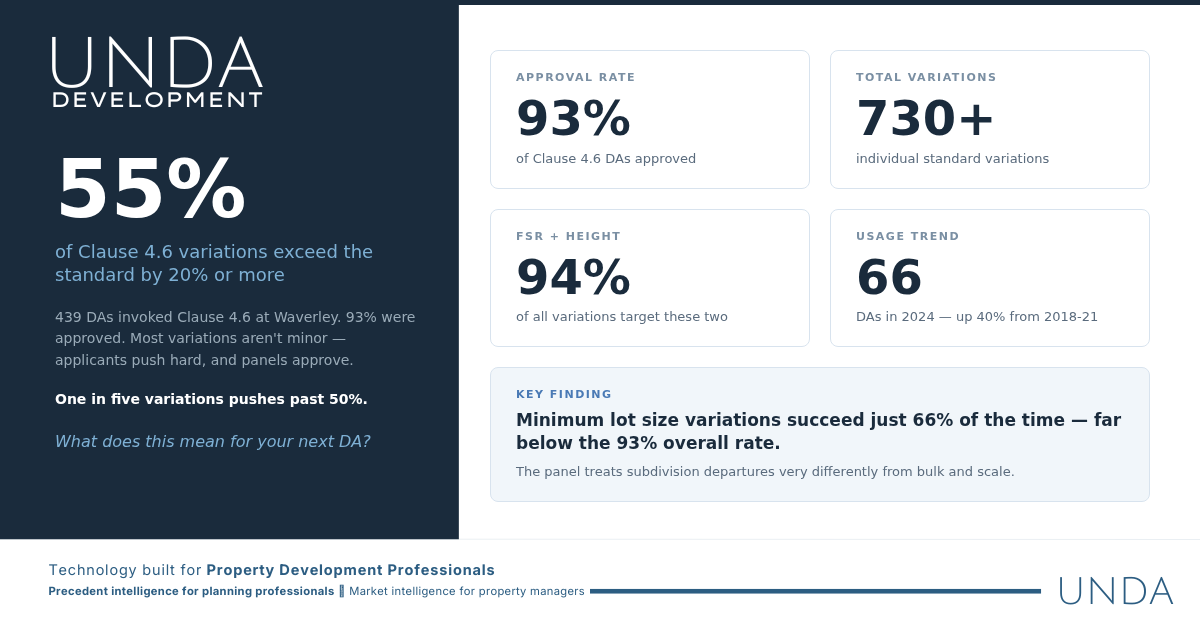
55% of Clause 4.6 variations at Waverley exceed the standard by 20% or more. These aren't minor adjustments — and panels approve 93% of them.
The NSW planning system just underwent one of its most significant structural changes in a generation. On 1 July 2026, the Development Coordination Authority went live — a single agency replacing referrals previously bounced between up to 22 separate bodies. The government is streamlining how DAs get assessed at the state level.
But what actually happens at the local level when an applicant asks to break the rules?
UNDA analysed every Clause 4.6 variation request at Waverley Council — 439 development applications, more than 750 individual standard variations, spanning 2017 to 2026. Here's what the data shows about when breaking the rules works.
93% of Clause 4.6 applications are approved
Of the 439 Waverley DAs that invoked Clause 4.6, 409 were approved — a 93% success rate. Just 30 were refused.
That number deserves context. As we explored last week, DAs that invoke Clause 4.6 are a specific population. These are professionally prepared applications with formal town planning statements justifying why the departure from the standard is acceptable. The high approval rate reflects the quality of preparation, not a permissive panel.
The 7% that are refused? Those are the cases where either the justification was weak, the departure was too extreme, or the standard in question goes to something the panel considers non-negotiable.
Floor space ratio and building height: 94% of all variations
Not all standards are varied equally. Two dominate overwhelmingly.
Floor Space Ratio (FSR): More than 400 individual variations across the dataset. The most frequently challenged standard by a wide margin. FSR controls how much floor area you can build relative to the site — and applicants push it constantly.
Height of Buildings (HOB): Nearly 300 variations. The second most challenged standard controls maximum building height.
Together, FSR and HOB account for 94% of every Clause 4.6 variation Waverley has ever considered. Minimum lot size for subdivision is a distant third at 29 variations.
This tells planning consultants something practical: if you're preparing a Clause 4.6 justification, the panel has seen hundreds of FSR and height arguments. Your reasoning needs to be specific to the site, not generic. The bar has been set by the 400 that came before you.
How far do applicants push?
Most Clause 4.6 variations are not minor adjustments — they're substantial departures from the standard.
Of the variations with a recorded departure percentage, 55% exceed the standard by 20% or more. One in five pushes past 50%. Only 15% are within 10% of the standard.
Applicants are not tiptoeing around the edges. They're asking for substantial departures — and panels are approving them. The question isn't whether you can vary a standard. It's whether your justification holds.
Not all standards are created equal
While the overall DA approval rate is 93%, the picture changes when you look at individual standards.
FSR variations are approved 78% of the time at the individual variation level. Height of buildings: 76%. But minimum subdivision lot size? Just 66%.
The panel is markedly more sceptical of lot size variations — departures that affect how many dwellings a site produces. FSR and height exceedances change the bulk of a building. Lot size variations change the pattern of subdivision. The panel treats them differently.
The trend: more variations every year
Clause 4.6 usage at Waverley has grown steadily. In 2018–2021, the panel saw roughly 47 Clause 4.6 DAs per year. By 2024, that number reached 66 — a 40% increase.
This isn't surprising. As sites become more constrained and development standards tighten, more projects need formal variations to proceed. The Clause 4.6 pathway is becoming standard practice, not an exception.
What this means for your next DA
If you're preparing a development application at Waverley and your design exceeds FSR or height controls, the data suggests a well-justified Clause 4.6 variation has a strong chance of success. But "well-justified" is doing the heavy lifting in that sentence.
The panel has approved 93% of these applications — but that 93% reflects a self-selected population of professionally prepared submissions. Walk in with a generic justification and you're competing against consultants who have done this hundreds of times.
UNDA Development tracks every Clause 4.6 variation, every departure percentage, and every panel outcome. Before you present, know what the panel has already approved — and what they've refused.
This is the second in our series on Waverley's planning data. Last week: We Analysed 853 Waverley Panel Decisions. Here's What Gets Approved.
About UNDA Development
UNDA Development provides precedent intelligence for planning consultants — every DA, every panel decision, every compliance record at your fingertips. Our sister product, UNDA Management, provides market intelligence for strata managers. Learn more at unda.management