
Average DA Processing Time: What 561 Panel Decisions Tell Us
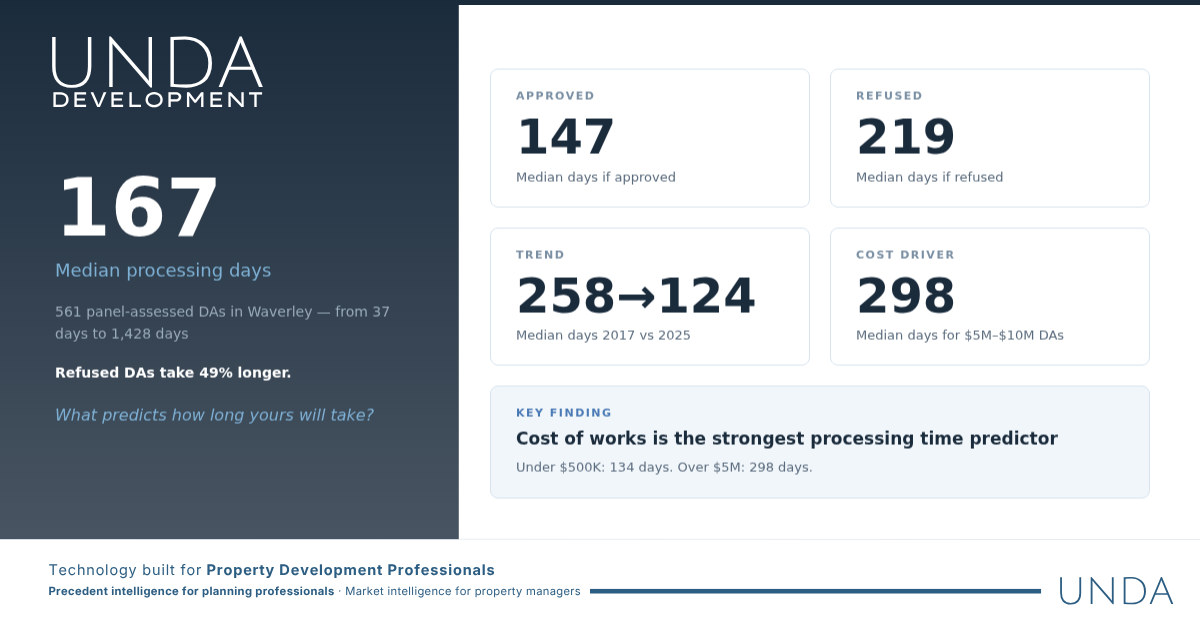
Median: 167 days. But the gap between fastest and slowest tells a bigger story.
In our Bondi Junction analysis, we found a median processing time of 145 days — and one DA that took 720. This week, we zoom out to the full dataset.
UNDA's Waverley database contains 561 panel-assessed development applications with complete lodgement and determination dates. The overall median processing time is 167 days — roughly five and a half months from lodging a DA to receiving a panel decision.
But that median conceals enormous variation. The fastest determination took 37 days. The slowest took 1,428 — nearly four years. What determines where on that spectrum your application will land?
Outcome predicts speed
The single strongest predictor of processing time is the outcome itself. Applications the panel approves outright have a median processing time of 147 days. Applications approved with modifications take longer — median 182 days. And applications the panel refuses take the longest at 219 days.
This pattern holds consistently: the median processing time for refused DAs is 49% longer than for approved DAs. Whether that's because problematic applications generate more rounds of assessment, or because longer assessments give more time for issues to surface, the correlation is clear.
The market is getting faster
Processing times have trended downward significantly since 2017. The median processing time in 2017 was 258 days — more than eight months. By 2020, it had dropped to 133 days. In 2025, it sits at 124 days, as of the data available.
The exception is 2022, when the median spiked to 205 days — likely a delayed COVID impact, with assessment backlogs from 2020–21 working through the system. By 2023 the trend resumed its downward trajectory.
This improvement isn't marginal. Applicants today wait roughly half as long as applicants did in 2017. Whether that reflects process reform, better pre-lodgement engagement, or simply fewer complex applications per assessment officer, the result is the same: the system is faster.
Suburb matters — but not as much as you'd think
Bondi Beach has the longest median processing time at 188 days, followed by Waverley (184) and Bronte (181). Dover Heights is the fastest at 146 days, with Bondi Junction at 161.
The spread between fastest and slowest suburbs is 42 days — meaningful, but not as dramatic as the 72-day gap between approved and refused outcomes. Suburb influences processing time, but outcome is a stronger signal.
Cost is the real driver
The clearest predictor of processing time is cost of works. DAs under $500,000 have a median processing time of 134 days. At $1 million to $5 million, it climbs to 195 days. DAs between $5 million and $10 million have a median of 298 days — more than double the under-$500K group.
The $10 million-plus category actually processes slightly faster (median 273 days) than the $5–10 million band. This may reflect better-resourced applicant teams at the top end — national architecture firms, experienced planning consultants, and comprehensive specialist documentation. DP #4 showed that approved DAs average 44% more consultant reports than refused ones, and the largest projects tend to bring the most thorough documentation.
What this means for applicants
If you're lodging a DA with Waverley Council today, the data suggests three expectations worth calibrating.
First, expect roughly 120–170 days for a panel determination, depending on your project's cost and complexity. That's down from 250+ days in 2017, and the trend continues to improve.
Second, the cost of your project matters more than the suburb. A $5 million renovation in Dover Heights will likely take longer than a $300,000 alteration in Bondi Beach, despite the suburb-level averages suggesting otherwise.
Third, preparation correlates with speed. The applications that move fastest through assessment tend to be the ones with clean compliance records and thorough documentation — not necessarily the smallest ones.
UNDA Development tracks 12,000+ development applications across Waverley and Randwick, including 1,362 panel-assessed items with full determination data. Analysis current as at August 2026.
This is the fifth in a series of data-driven analyses of NSW planning panel decisions. UNDA Development is building the precedent intelligence platform that makes this analysis available for every application, every panel, and every council.
About UNDA Development
UNDA Development provides precedent intelligence for planning consultants — thousands of panel decisions, DA outcomes, and compliance records structured and searchable. Our sister product, UNDA Management, provides market intelligence for strata managers. Learn more at unda.management