
Where NSW's New Strata Stock Is Actually Landing (It's Not Where You Think)
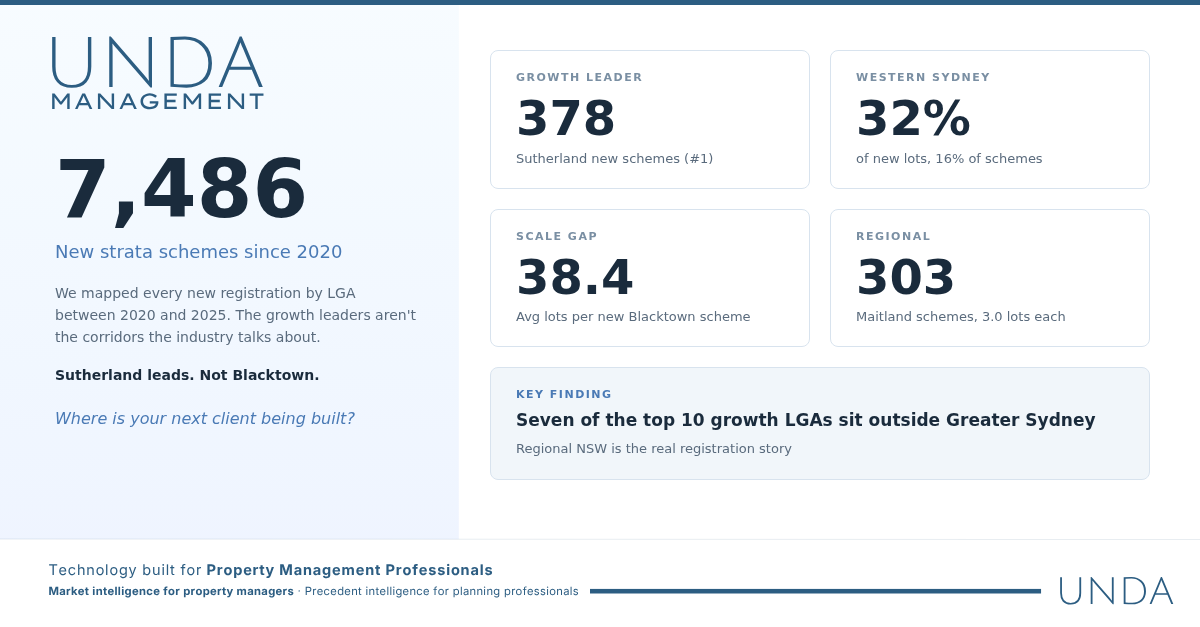
7,486 new scheme registrations over five years. The growth leaders aren't who you'd expect.
Ask anyone in the industry where strata growth is happening, and they'll say Western Sydney. We checked. They're half right.
UNDA has tracked every new strata scheme registered in NSW between 2020 and 2025 — 7,486 buildings still active today, containing 105,817 lots. When you map where that new stock is landing, the assumptions about growth corridors don't hold up.
The real growth leaders
The LGA with the most new strata registrations since 2020 isn't Blacktown. It isn't Parramatta. It's Sutherland — 378 new schemes. The Shire.
Newcastle is second at 323, followed by Penrith at 320. Maitland — a regional LGA most strata managers wouldn't have named — sits fourth at 303. Wollongong rounds out the top five at 294.
Look at the top 10 and the pattern becomes clear: Shoalhaven (277), Port Macquarie-Hastings (259), Central Coast (258), Ballina (257), Shellharbour (237). Seven of the ten highest-growth LGAs sit outside Greater Sydney entirely.
This is the story the industry conversation misses. The new strata stock isn't concentrated in the Western Sydney corridor everyone talks about. It's distributed across regional NSW — the Hunter, the Illawarra, the Mid North Coast, and the Northern Rivers.
The Western Sydney paradox
Western Sydney isn't absent from the growth story. It's just a different kind of growth.
Across eight Western Sydney LGAs — Blacktown, Parramatta, Cumberland, Fairfield, Liverpool, Campbelltown, Penrith, and Canterbury-Bankstown — 1,206 new schemes were registered between 2020 and 2025, containing 34,085 lots. That's 16.1% of all new schemes statewide but 32.2% of all new lots.
The math tells you what's happening: Western Sydney is building fewer, much bigger buildings. Blacktown's 218 new schemes average 38.4 lots each — nearly three times the statewide average of 14.1 lots per new registration. Compare that to Maitland, where 303 new schemes average just 3.0 lots. Similar registration counts, completely different building type.
For strata managers, this distinction is critical. A new 38-lot apartment complex in Blacktown and a new 3-lot duplex conversion in Maitland both count as one new registration. They are not remotely the same business opportunity. The same growth metric describes fundamentally different outcomes depending on where you look and what you measure.
Who's winning the new stock?
The managers capturing the most new registrations in growth corridors aren't the names that dominate Sydney's strata market.
Lake Group Property Services leads with 84 new schemes across the top 10 growth LGAs. Strata Management Specialists follows with 73. Wollongong Strata sits at 69. Network Strata Services has fewer schemes at 65 but far more lots — 2,538 — suggesting it's capturing the larger new developments.
PICA Services, the dominant force in Sydney's established market, ranks fifth with 52 new schemes in growth corridors. The regional operators are winning the regional growth.
This makes sense. New strata stock in Sutherland, Newcastle, and Wollongong is being captured by firms with existing relationships with local developers, proximity to building sites, and established operations in those markets. A Sydney-based national operator can compete for individual large buildings, but the volume of smaller regional registrations flows to managers with local presence.
What this means
If you're a strata manager planning your growth strategy, the new registration data suggests three things.
First, total scheme count growth is a regional NSW story, not a Western Sydney story. The Shire, the Hunter, and the Illawarra are producing more new strata buildings than any Western Sydney LGA except Penrith.
Second, Western Sydney's growth is real but structurally different. Fewer buildings, bigger buildings. The contract value per new registration is higher, but the volume of new management contracts is lower.
Third, the managers winning new stock in growth corridors are mostly regional operators — not the corporate groups that dominate Sydney's established market. If you're a Sydney-based manager looking to capture new registrations, you're competing against firms with home-ground advantage.
UNDA tracks every new registration as it lands — by LGA, by building size, and by which manager captures it. If you want to see where the next opportunity is before your competitors do, contact us.
About UNDA Management
UNDA Management provides market intelligence for strata managers — 89,000+ NSW schemes mapped, every manager linked, every contract cycle tracked. Our sister product, UNDA Development, provides precedent intelligence for property developers and property planning consultants. Learn more at unda.management